1.04.2013

Rise of the Healthcare Pricing Tools

The notion "you get what you pay for" almost always holds true for general merchandise like clothing and related accessories. The high-end brands are usually expensive because their quality is directly proportional to the price of the product. Comparatively in case of healthcare, the price variances can be a little tricky and are tied to more than just the quality of the procedures.


Healthcare cost differentials

The cost of different kinds of treatments in a given area, city or state can vary substantially because they are dependent on fee schedules, demographics, and physician overhead.

A procedure like Lasik surgery can cost up to $4500 in New York while the exact same procedure runs for about $2800 in Ohio. Both of these treatments are about the same if judged on the scale of quality, procedure implementation, physician experience and time and yet there is a huge difference in cost.

Why the rise of the pricing tools?

Come 2014 the Affordable Care Act (ACA) will require everyone to get insured or face a penalty. This combined with the elimination of the pre-existing condition clause and the defined contribution model will put financial pressure on the whole industry and will create a consumer driven healthcare.

To stay afloat, the insurance companies will underwrite all subscribers as being under the same umbrella which will tie all participants together with an invisible financial thread. This thread will cause all participants to suffer equally for someone else not being able to pay their bills.

To ensure no one defaults on their payments and can afford the care, both the insurance companies and the consumers will demand to know the estimated cost of the treatments before they begin. This demand will give rise to the pricing tools.

Aspects that will matter

Pricing tools will be more than just a mere quoting system. Other facets like hospital versus private facilities, satisfaction ratings, availability and physician experience will equally count.

The consumer driven healthcare model will depend on:
  • How is the reputation of the hospital or a physician's office?
  • What kinds of deals are available inside or outside the plan network?
  • Is the physician willing to offer discount rates to individual customers?
  • What kind of satisfaction ratings did the physician receive?
  • What percentages of outcomes were successful?
  • Is there a price difference between a doctor's facility and a hospital?
  • Are there any payment plans available?

Different types of pricing tools

There are three primary ways of implementing the quoting system: the bluebook approach, the insurance average and the true cost quoting. All of these systems will have an Expedia-like feel with some even offering online shopping through a cart system.

Bluebook approach

Bluebook models already exist in the market but they tend to have a higher chance of deviation from the true estimates. They gather the pricing information from data bank companies like Vitals and then calculate the estimate by taking the averages.

The reason the bluebook approach is not realistic is because it does not take different, more-detailed possibilities into account, remove outliers or have access to different fee schedules. For example: A dental implant surgery can have the possibility of including a bone graft if the jawbone is too small. This is something that bluebook pricing would have trouble representing properly.

Insurance average

In this approach the pricing statistics are created by mining the claims data from different insurance companies. During the calculations the resultant information is further refined for accuracy by removing the outliers from the source costs.

Systems that offer cost information by mining claims data are usually more accurate than their counterparts. The weakness of this system comes from the absence of individual data like copays and deductibles.

True cost quoting

True cost systems are designed to offer more realistic estimates and are geared towards churning out individual estimates. The costs for different treatments are calculated using the same methodology as the insurance average models and then individual deductibles, copays and out-of-pockets are applied. The end result varies from user to user depending on their standing in their plan.

Opportunities and Challenges

The employer contribution model, ACA and consumer driven healthcare will force employers, hospitals, insurance companies and physicians to change their business models. Information and data availability will be at the center of this change.

Hospitals will have to rethink the patient exit surveys, feedback management and the way they charge their patients. Hospitals and doctor offices will be in a state of covert competition which will bring down prices for certain types of treatments.

Price comparison tools are already available in the market but they are not effective enough if they cannot utilize one's copay or deductible in the equation. Insurance companies will have to connect and offer data to their pricing tool vendors so that real-time quote calculations can be made.

Web presence for doctors will not just be "good to have" anymore - consumers will expect doctors to maintain a website. There is a vast opportunity present for software development houses to offer some kind of IT services to doctors because due to the ever increasing costs and overheads as it will be hard for physicians to hire IT staff directly.

Other reasons to maintain a solid web base are so that the physician can contact his/her patients electronically and get their feedback personally. We should not forget that the majority of the consumers leaving feedback on the public pricing tools will be the unhappy campers. Physician websites will allow physicians to showcase their good cases tilting the negative bias towards a positive one from the public areas.

1.03.2013

Landing Promotions and Raises

Money is one of the key rewards for excellence and is a catalyst to increased motivation. However, pay raises are often mistaken to be intertwined with promotions. A promotion is not and should not be the only way to get a healthy raise. 

This is a second post in the work success series. To read the first one, please visit Become Indispensable & Recognized at work.

The case that I tried to make in my first post was that you need to get recognized for being better than average. When you succeed in getting recognized for being better than average, you proceed towards further improving yourself and being extraordinary. When you are extraordinary, you see many options open unto you.

A pay raise is what you employer rewards you with in return for your hard work because your performance level has surpassed your current pay level. Promotions are additional responsibilities that are given to you because you have successfully demonstrated that you have the knowledge and the capacity to lead in a higher role.

Raises and promotions both require hard work and over delivery as pre-requisites. Both are forms of opportunities made possible by the presence of all the slackers. All you have to do is get ahead and avail these opportunities. It is easier than what most people think it is.

Here are some tips and traits that you can develop to score your dreams.

Create an appetite for success

Are you truly ready for your success? How bad do you want it?

I believe that success, wealth and happiness can be achieved by anyone. The probability of our success is directly relational to how bad we want to reach our goal. When it comes to pursuing our dreams, we will need to want them as bad as we want to breathe.

It is certainly true that luck plays a huge role in one’s success. But how do you define luck? In my view, luck is nothing more than one’s preparation meeting the opportunity. It is better to be prepared when opportunity knocks than seeing all kinds of lucky strikes pass you by.

You will need to learn to use your luck! I can give you opportunities all day long, but if you are not ready for them, you cannot avail any of them.

Develop the right attitude

Your attitude is what regulates your energy and the energy that you emit toward others. Four types of attitudes are common among successful people: attitude towards change, correction and advice, teamwork and gratitude.

Attitude towards change

The ability to look for opportunities at the time of change and capitalize on them will open new doors of luck for you. Being resilient towards change will do nothing positive because you cannot stop or avoid change.

Attitude towards correction and advice

One way to show your boss your determination towards being successful is by asking for feedback. However, you can completely destroy the usefulness of that feedback if you cannot listen to your boss without blocking the information or being defensive.

Some of the best advice that helped me with my career came from my bosses. I paid attention to what was being said and how could I improve my shortcomings. If I didn’t understand, I would ask for clarification. The more you understand and act on the feedback, the higher the respect your boss will have for you.

In my career, my mentor Tracy Hall helped me polish my project coordination skills. My manager Jacqui Schmotzer gave me tips on improving my communications skills. Bob Schleichert who was an Associate VP, showed me how to hire, negotiate, plan and budget for large scale undertakings. Kevin Pete, a Senior VP, taught me how to put it all together and be an effective leader.

So, you see, there is one thing common among all of the bosses I had, they all gave me feedback and opportunities, and left it to me whether I avail them or not. This also means that a true leader will play a key role in your success; hence make sure the one you are working for has those qualities!

Attitude towards teamwork

Your willingness towards helping your coworkers is a reflection of your leadership. Being able to jump in when needed and help others with their problems will earn you extra points.

Attitude towards gratitude

Your chances of success are slim if you cannot think of anything to be grateful for from your employer. Not to say that there are bad employers out there, but the majority of the time it is us who needs to change our perception.

You can improve your perception by a simple exercise. Take a piece of paper and write down everything you can think of that you like at your place of work. Do this over and over again until your sheet is full. This will affect your behavior and your employer will clearly be able to see your gratitude through your behavior.

Don’t be afraid to lose

Don’t let the fear of losing keep you away from accomplishing your dreams. The real loss we suffer in our life is when we cease to try something out of the fear that we will end up making fools out of ourselves.

I used to have a great deal of fear of public speaking. Having known this weakness, I still volunteered to speak about our experience at the graduation ceremony of Aultman Exploring Leaders. Mind you that this graduation event was attended by many high level executives at my company.

My speaking endeavor ended up anything but a Cinderella story; I panicked so bad that I forgot what I was going to say next. After subjecting my audience to a painful 30 seconds of silence, I managed to say some last words and ended my speech. Needless to say, I was furious, embarrassed and angry at myself.

I used those emotions of embarrassment and anger to improve myself by practicing hard. My next chance came three months later in form of an IT presentation. I practiced my speech in front of a mirror, friends, family and my pet cat. Finally the big day arrived and I sailed through my speech like a seasoned presenter. I tell you that the joy and the euphoria I felt after the speech was inexplicable and tastefully addictive.

Earn the flexibility

We all know that family and personal life is very important; however, in order to have a fair balance between work and personal life, you will have to work harder. Your boss will show flexibility around your family needs if your work is on time, is of high quality and you are there when your boss needs you. The secret to earning flexibility is to over deliver!

Bottom line

You should see an equitable increase in your pay if you truly are extraordinary and an over-achiever. However, if being a leader is your cup of tea and you want to go further down the rabbit hole, please stay tune for my next post in this series: Become an effective leader.

1.01.2013

No real Medicare solution in 2013 Fiscal Cliff deal

I was hoping, or to put it more accurately, dreaming, that the senate and the house will give sequestration and SGR a reasonable thought during the fiscal cliff discussions. Looking at the outcome I fear a gradual drop in the number of physicians dealing with the Medicare.

The fiscal cliff bill (HR 8) passed by the Senate delayed the Medicare payment cuts by one year. Current rates will continue until December 31, 2013, and at that time this patch will require more action.

Hospitals will pay for the delay

Besides not enacting a permanent fix, the other disturbing part is the cost of delaying is offset by requiring hospitals to fill the bill. Republicans did propose to pay for the bill through cuts to ACA and its beneficiaries, which the Obama administration overwhelmingly rejected.

Medicare cuts has no positive outcome

Hospitals will suffer because they will see reduced payments due to Medicare payment cuts and Disproportionate Share Hospitals plan. Physicians will suffer because they will either have to eat their losses or mitigate them by limiting their involvement in the Medicare program. Insurance companies will suffer because a reduction in Medicare physicians will affect their Advantage Plan’s provider network.

Doctors will leave Medicare

Many patients are questioning the old belief that doctors were supposed to join medical field to help people. Money should not be the primary factor. Some have gone so far as to say that professional honor is replaced by the goal of running a profitable venture, and I could not disagree more with this theory.

Doctors still join the medical field to help people, because many of these talented men and women could have gone onto other professions with more money, less hours and less hassle. But considering the large sum of medical school debt they accrue and the overhead of running their facility, the actual salary they are paid is like a rain drop in a desert.

Bottom line

Sequestration is a very serious problem which is not created by doctors in general. Instead of enforcing the existing laws, rules and regulations, the Government is further punishing care givers by adding more rules while leaving them hanging and guessing for the final outcome for another year. This will bring no positive change but force doctors to opt out of these programs.

12.31.2012

Become Indispensable & Recognized at Work

Have you ever felt that some individuals travel through the ranks and receive recognition relatively easy compared to others? In some cases so much so that it seems like the handy work of sheer luck. This type of phenomenon is quite common to the candidates who share specific traits.

12.26.2012

Understanding Kabbalah and the Tree of Life

Things we smell, touch, hear and feel tell us where we are in time and space and this moment describes our reality. However, this notion of perceiving our reality is only valid if judged through the five senses; which begs the question that if our reality is actually the way we perceive it?.  Quantum Physics has shown that our reality sometimes may not be what it seems; and that is where the wisdom of Kabbalah comes in. Kabbalah is not a religion, a cult or magic; rather it is a manual for the human body to get in touch with its own reality.

12.22.2012

Sending HTML emails with embedded images using C#.NET

Sending emails using ASP.NET is relatively easy, but sending emails in html format with images embedded in them is a little tricky (not difficult at all though). Keep in mind that embedding images within the email is not the same as attaching images to emails. The embedded images appear inside the content of the email with no sign of any attachments.

12.15.2012

Sandy Hook elementary school shooting

Friday's mass shooting at Sandy Hook elementary school was the worst in a string of sad events in the recent years. Whether the shooting happened at a school, shopping mall, Temple, movie theater or outside in the bright daylight our response has disturbingly been similar with no real results.

12.13.2012

Notable Highlights of Federal Health Exchanges

Healthcare exchanges will bring in both opportunities and challenges for Health Insurance companies. Plan building, pricing, customer education and brand recognition will play a top role in the coming years. Here are some of the notable highlights in regards to the Health Exchanges.


Readiness dates are closer than they appear

Even though the regulations come in on January 2014, the enrollment will have to start in 2013. This means that the health plans will have to have their exchange participation ready by October 2013. The readiness for the exchange is a large topic in itself. Connecting with the exchanges will require the ability to accept and create 834 and 999 responses, factor subsidies when processing plans and premiums and the ability to process the financial data coming in from the exchange.

Risk adjustment and cost

The ruling requires insurers to accept everyone without discriminating against chronic illnesses or preexisting conditions. Due to this, the underwriters will underwrite everyone as a whole and hence distribute risk and cost.

Government as an employer

Traditionally if you have healthcare coverage through your employer, your employer pays part of your monthly premium and the rest comes out of your paycheck. Similar to the employer based health coverage, the health exchange pays part of your premium through subsidy and you pay the rest. So the subsidize care turns the government’s role into more like that of an employer.

Subsidy based coverage & the penalty

To ensure that both the sick and healthy people get on board, the penalty and the subsidy system came into being. Come 2014, everyone will be required to get health insurance and depending on where one stands on the poverty index scale, the IRS will either pay a credit towards the monthly premium or will charge a penalty if an individual fails to get insured. How much money the IRS pays to the health plan for an individual depends on how large of a subsidy that person is eligible for.

Subsidies and the silver plans

Even though the subsidies are based on the poverty level, the second lowest cost of the silver plan in your region plays a major role. For example: your subsidy in Ohio will be different than the one you will get in Pennsylvania under the same exact income and poverty level if the silver plan rates are different in the two states.

A point to note is that even though your subsidy is based on the silver plans, you are not obligated to buy a silver plan. You can always use that subsidy against other plans such as a bronze one.

Small employers

Small employers with 50 or less employees will not be required to provide health insurance to their employees, but will be eligible to get tax credits should they do so through federal exchange. The subsidy itself will not be significant enough to make any dent in their insurance costs which is why we will see the small business workers applying for tax credits and enrolling as individual subscribers.

Technology will not eliminate the human intervention

Whether health plans participate in ACA through federal, state or private exchanges, the technology will not eliminate the need of customer service to assist people with their enrollments. There will be lots of enrollees who never had insurance before or never had to deal with having to make a decision to choose between what benefit is right for them or having a full understanding of what is the difference between gold, silver, bronze or a platinum plan.

All health plans should be ready to offer some kind of education to its enrollees about the choices and their impacts.

Subsidies, taxes and income raises

Getting educated on how the personal taxes will be impacted by the subsidies and income changes will be another critical task for the enrollees. For example: An individual making a $20k annually getting a subsidy of $200 per month will actually end up owing the IRS money if that individual received a pay raise within that year and failed to report it right away.

The moment there is a change in the pay level, the IRS will need to be notified so that the subsidies can be recalculated.

Bottom Line

There will be a large influx of customers that will be making purchase decisions based on brand recognition, brand alliances, provider network, hospital network, premium pricing, subsidy levels and the quality of the benefits being offered.


12.11.2012

Broken system of Medicare, SGR and the Sequestration

Would it make sense if you’re told that not only you are not getting a raise this year but your pay will be cut by n% because the US economy didn’t do well this year? In a nutshell this is actually how Medicare cuts (known as SGR) works.

11.14.2012

Different ways to deploy a webpart on Sharepoint 2010

When you are done developing a WebPart, you need to deploy it to the SharePoint server. However, depending on your server setup, you may have to use specific deployment methodology and that is why it is important to know your options. This post describes different ways to achieve this goal.


Basic understanding

Whatever method you use to develop your WebPart, you will always end up with a WebPart DLL and in some cases you will have WSP file (both of these files are in debug folder of your project). It is the DLL file that plays a key role in getting your WebPart inside SharePoint server.

Ways to deploy a WebPart

There are four ways we can deploy a WebPart on SharePoint server that I will cover in this post:

  1. Using Visual Studio to deploy the solution
  2. Manually moving the DLL to the server
  3. Uploading WSP to SharePoint server
  4. Deploying through command prompt

Pre-Requisites

I am assuming that you are all done with the development and are now ready to deploy. In these examples I have a project name "FeedbackWP" that I need to deploy.

Deploying through Visual Studio

Once the coding is complete, click on build > deploy


In the output window you should see the deployment success status.


For next steps please look at "After you webpart is deployed" section at the end of this post.


 Deploying by manually moving the DLL


Build the solution


If no error returned by the compiler, copy the DLL from your project bin > Debug directory to the bin directory of your WSS site (C:\Inetpub\wwwroot\wss\VirtualDirectories\80\bin).


Go to (C:\inetpub\wwwroot\wss\VirtualDirectories\80\) and modify the Web.Config file for the WSS site to declare the custom web part as a safe control by adding the following code within the <SafeControls> tag.

<SafeControl Assembly="DLL-Name-Here" Namespace="DLL-Name . NameSpaceHere" TypeName="*" Safe="True" />

In my case my dll name is feedBackWP and the namespace of my webpart is InputForm; so my SafeControl entry looks like:

<SafeControl Assembly="feedBackWP" Namespace="feedBackWP.InputForm" TypeName="*" Safe="True" />

And my webconfig looks like the image below:


Now we need to add this webpart to our Sharepoint gallery.

Click on Site Actions -> Site Settings -> Web Parts.


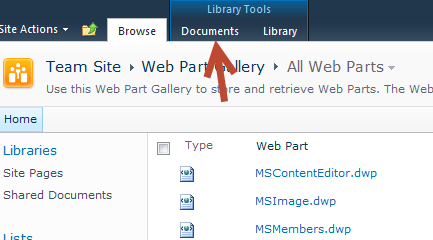
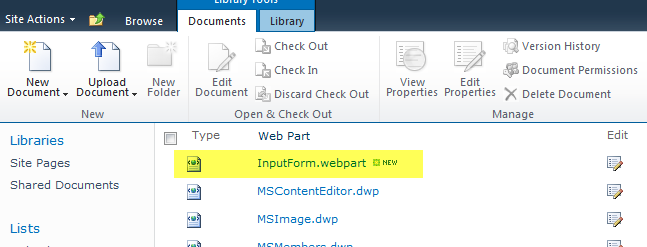
From Web Parts page click on Documents > New Document


New Document will bring up a pop-up window. This window should have your new web part listed. Select your webpart from the list and click on Populate Gallery.


If the import is successful, you will see the web part in Web part gallery list.


For next steps please look at "After you webpart is deployed" section at the end of this post.


Deploying by uploading WSP to SharePoint server

Build the solution


If no error returned by the compiler, you will have WSP file in your project bin > Debug.

  Open Sharepoint and click on Site Actions -> Site Settings -> solutions.


From solutions page click on solutions on top and after clicking it, you should see upload solution tab.


Click on upload solution and it will bring up a popoup to upload your webpart.


Upload your WSP file.


If uploading is successfull, you should see the webpart appear in the solutions list.


Activate the solution and thats it.


For next steps please look at "After you webpart is deployed" section at the end of this post.


Deploying through command prompt

Build the solution


If no error returned by the compiler, you will have WSP file in your project bin > Debug.

Copy the wsp file on the server and open up a command line and navigate to the 12-hive bin folder.
(my 12-hive bin folder is C:\Program Files\Common Files\Microsoft Shared\Web Server Extensions\14\BIN
Enter the following commands :

stsadm -o addsolution -filename WSP FILE NAME WITH LOCATION

stsadm -o deploysolution -name WSP FILE NAME -immediate -allowGacDeployment -url  SITEURL  


So in my case these commands become:

stsadm -o addsolution -filename c:/feedBackWP.wsp

stsadm -o deploysolution -name feedBackWP.wsp -immediate -allowGacDeployment -url ht
tp://bk-laptop-hp/


For next steps please look at "After you webpart is deployed" section.


After your Webpart is deployed

Go to the SharePoint site and click on Site Action > New Page.


From new page click on Insert and then on WebPart.


From WebPart list click on custom (NOTE: In some cases this is miscellaneous instead of custom). This should bring up our WebPart on the right hand side.


With the WebPart selected click on the add button.


Happy programming!

11.13.2012

Using WebPart to insert data into SharePoint List

Here is a quick tutorial on how to insert data into a SharePoint list using a web part. The web part will have an input form for the users and when submitted, will add the data to the list. I have used SharePoint 2010 and Visual Studio 2010 in this tutorial.

Contact Form

Name

Email *

Message *

 
POPULAR POSTS
TAG CLOUD